
AI Won’t Replace Copywriters
Written by Roger Mulleron July 22nd, 2026
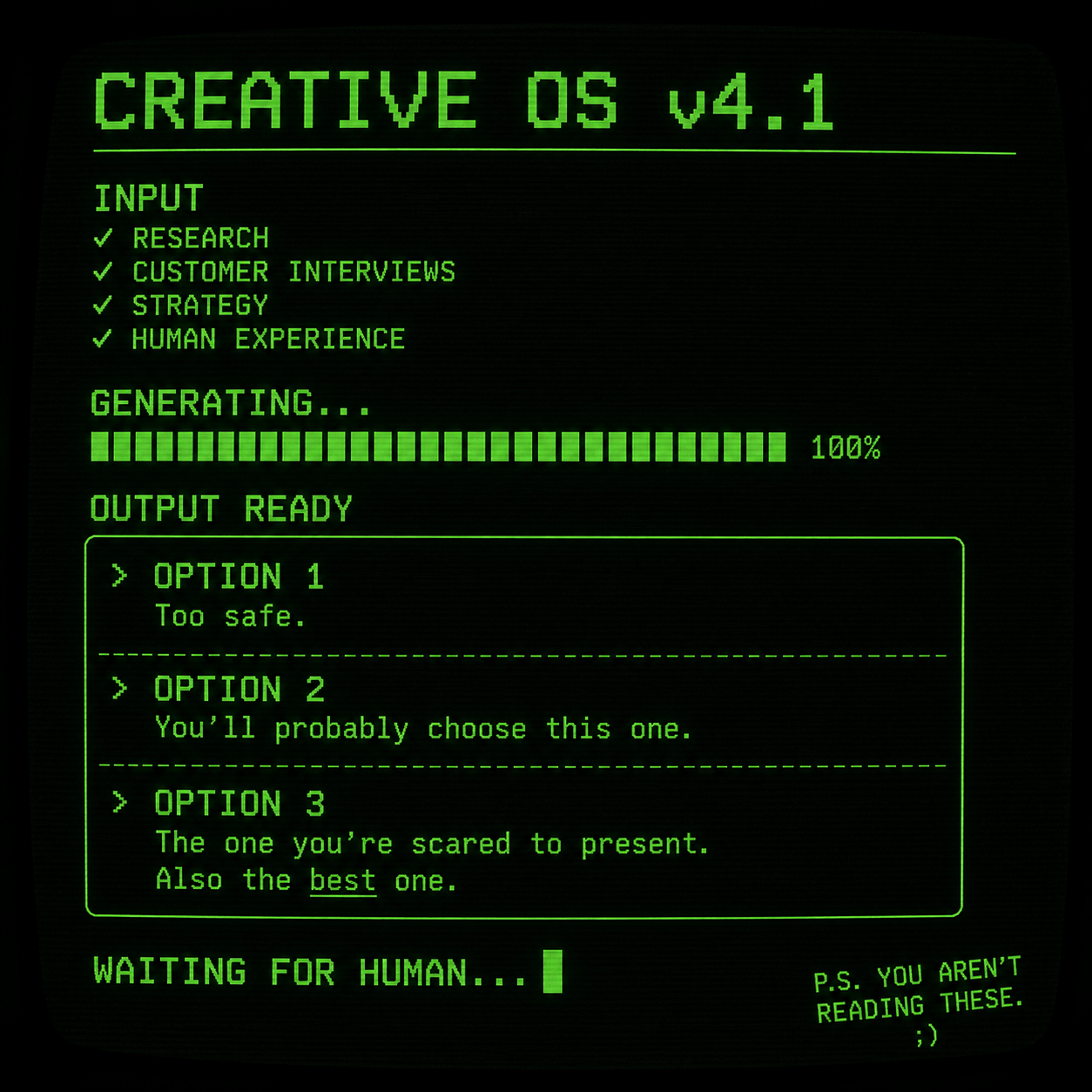
It will make the good ones better.
Every few years, our industry gets a new tool that promises to change everything.
Desktop publishing. Photoshop. Google. Social media. Smartphones.
Today, that tool is artificial intelligence.
Depending on who you ask, AI is either the end of creativity or the greatest creative assistant ever invented. The truth is somewhere in between.
AI isn’t replacing the copywriter. It’s replacing the blank page.
From first draft to better thinking
Most people think AI is useful because it can write.
That’s actually the least interesting thing it does.
The real value is in helping creatives think more broadly, refine ideas faster, and challenge assumptions before the work ever reaches a client.
Instead of asking AI to “write an ad,” try asking questions like:
- What assumptions am I making about this audience?
- What’s a completely opposite approach?
- How would Gen Z react to this concept?
- Is this headline emotionally driven or just informative?
- What objections haven’t I considered?
- Give me ten terrible ideas so I can discover one great one.
Those prompts don’t replace creativity. They expand it.
Great ideas still come from people
Every memorable campaign begins with an insight.
AI doesn’t have life experience. It hasn’t fallen in love, raised kids, lost a job, watched a sunset over Lake Tahoe, or experienced the frustration of standing in line at the DMV.
People have.
Those experiences create empathy, and empathy creates advertising that resonates.
AI can recognize patterns, summarize research, and generate options, but it can’t replace human intuition. The creative leap? That unexpected connection that makes someone laugh, cry, or think differently? It’s still ours to make.
Refining concepts, not replacing them
Where AI shines is in refinement.
Imagine you’ve landed on a campaign concept.
Now ask AI to stress-test it.
- Does this idea speak to our target audience?
- Is the tone consistent?
- Is there a stronger emotional angle?
- Are we relying on category clichés?
- Could this concept work across social, video, outdoor, and digital?
- What would someone outside our industry think?
Instead of spending hours chasing different directions, you can evaluate dozens of possibilities in minutes.
The creative director still decides what lives and what dies.
AI simply makes the room bigger.
Knowing your audience better
One of AI’s greatest strengths is helping creatives see beyond their own perspective.
A campaign aimed at first-time homebuyers should sound very different from one targeting retirees.
A message for Gen Z should feel different than one for healthcare professionals.
AI can quickly identify language, concerns, motivations, and cultural references that resonate with different audiences. It becomes another research tool, one that helps ensure we’re writing for the customer instead of ourselves.
That doesn’t eliminate research or strategy.
It accelerates both.
Creativity isn’t about answers
It’s about better questions.
Some of the best AI prompts aren’t requests. They’re challenges.
What if we’ve got this all wrong?
What’s the weirdest version of this idea?
What’s the opposite of every competitor?
What’s the emotional truth behind the product?
Those are the kinds of questions that lead to memorable campaigns. They’re also the foundation of bold creative thinking. As our own Creative Guide reminds us, breakthrough ideas often come from challenging assumptions, embracing absurdity, and prioritizing emotional logic over rational messaging.
AI simply gives us another way to explore those possibilities.
The future belongs to creative thinkers
Clients aren’t hiring agencies because they need more words. They’re hiring us because they need better ideas.
The copywriter of tomorrow won’t compete with AI. They’ll collaborate with it. They’ll direct it.
The professionals who thrive will be the ones who know how to ask better questions, recognize stronger ideas, and shape technology into work that feels unmistakably human.
AI can generate thousands of headlines.
Only a creative can recognize the one worth making.
That’s a skill no algorithm can replace.